Series And Limits
Geometric Series
Sequences of numbers occur naturally, and with notable frequency they fall into the category of the Geometric Series. The series of ratios expressible by a compact formula, being considered first as a finite series of ratio powers and then the limit is taken, where the number of ratios being summed goes to infinity.
The Geometric Series is associated with one appearance of $n$ and it's in the exponent position. The Series is expressed as a sum of terms, the kernel of which is, $r^n: 0 \lt r \lt 1$, where the index, $n$, is dictated by the summation symbol entailing the domain of it.
$$\begin{equation}\label{GS_S_g} S_g=\sum\limits_{n=0}^\infty\ r^n = r^0 + r^1 + r^2 + r^3 + \cdots \end{equation}$$
Since the starting term is $n=0$, the series is always being offset by one, regardless of $r$. Review the article on this if necessary: $1=r^0$ .
For the Geometric Series or common ratio equal to one half, we observe the post-zeroth sequence displayed (each on top the previous) in a unit-length horizontal rectangle as forever adding a half again of the previous term in the summation thus quite probably equalling one (we will see the exact formula below), by induction on the following seven terms of the series:
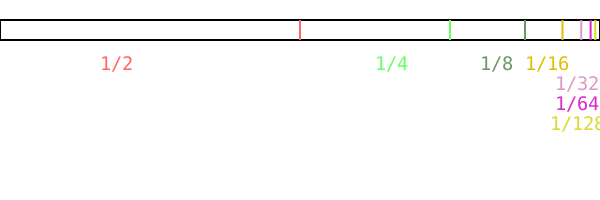
When we employ an $r$ value of less than one half then the summation is less than one (total sum less than two, including the zeroth term), which is graphically depicted in the same unit rectangle, so we generalize $r\lt 1/2$ for any $r$ the sum gets closer to zero, but we really need a formula.
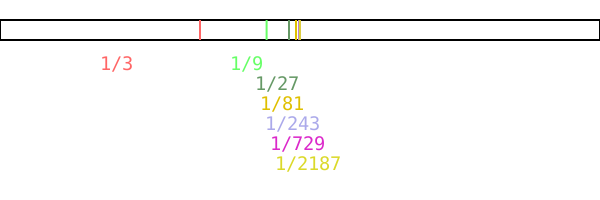
The sequence of sides ($1/2 + 1/4 + 1/8 +\ldots$) correctly (appears to) sum to one, because the sequence is comprised of steps which each leave a remainder of the unit (1) as $2^{-n}$—halving the distance to the unit. The Geometric Series of one third, $r=1/3$, converges to $1/2$ without the zero term.
Geometric Series Theorem
The exact formula for the Geometric Series is as follows:
Where $r$ is a constant fraction $0\lt r \lt 1$, with the variable being $m$. This compact formula is apparent after the following steps, thanks to Bernouli. First we take the partial series (sum of the series to some finite $m$), and multiply by the binomial $(1-r)$:
$$ (1-r)\left(\sum^{m}_{n=0} r^n\right) $$
Note the series we want to work with is the one that starts with $n=0$. Which is to say subtract, $r$-times the zero-based series from that same series, like so: $(1-r)S_m=(1)(S_m)-(r)(S_m)$.
$$ = (1 +r + r^2 +\dots+r^m)-(r + r^2 + r^3 + \dots+r^{m+1}) $$
Since there isn't a one in the second set of parentheses (series on the right starts with the $n=1$ term), and there is a $n=0$ term in the left parentheses, we have a one in the sum output followed by the last term left unpaired in negation $rr^m=r^{m+1}$.
$$ = (1) +(r-r) + (r^2-r^2) +\dots+(r^m-r^m) + (0-r^{m+1}) $$
Finally we are left with the following reduction:
$$ = 1-r^{m+1} $$
And so the formula is completed, after adjusting the formula for the appropriate starting term of the desired series. Changing the variable in the geometric series formula, as $m=n-1$, shifts the formula by one on the input:
$$ S_{n-1}=\sum^{n-1}_{x=0} r^x = \frac{1 - r^n}{1-r} $$
For the limit $n\to \infty$, the series is simply:
$$ \begin{equation}\label{GeometricSeriesTheorem} \sum_{x=0}^\infty r^x = \frac{1}{1-r} \end{equation} $$
And now we can resolve the mystery of whether or not the case of $r=1/3$, excluding the zeroth term, does converge to $0.5$, which it does since $S_g(1/3)=3/2$. And, a look at the ratio of a half, $S_g(0.5)=2$, proving the infinite sum not including the zeroth term is one.
Below are plots of the partial-sums of the geometric series for $r=\{1/4, 1/3, 1/2, 3/5\}$, which includes the points continuously between each of the integer points ($n$) by using a continuous variable $x$ and highlights drawn for $n=x=\{1, 2, 5\}$. Note that the plot ordinate range starts at one because the $n=0$ term is being included.
And, for the infinite summation, eq. \eqref{GeometricSeriesTheorem}:
The one-over-one-minus-$r$ function (the infinite sum formula) is valid for ratios $r\lt 1$, and as $r$ gets closer to one the function gets arbitrarily large, because you can make the denominator, $1-r$, arbitrarily small.
Harmonic Series
Before the closed-form discovery of the area under a hyperbola, Johann Bernoulli had proven that the Harmonic Series diverges, in 1689 AD. The Series is the infinite sum of fractions, similar in that way to the Geometric Series, but the kernel for this series is $(1/n)$, not $(r^n)$. The Series was given its name for the harmonic overtone contributions to the primary vibration (note, standing wave) of a stringed musical instrument. First, the divergence of the series is established to be a function of its being unbounded, en route to comparing the series to the area under the hyperbola, $y=1/x$, as described by the natural logarithm.
The starting term of the Harmonic series is $n=1$, since the inverse of zero is infinite. The partial sum, called a Harmonic Number, symobolized as $H_m$, is the sum from term one up through the $m$'th term as follows,
Bernoulli proved the divergence of the series by constructing the series from partitions of the sequence, each difference of harmonic numbers was chosen for its approximation to unity, so that the sum of the unbounded series is in fact unbounded, in a logarithmic way.
$$ \sum\limits_{n=1}^\infty n^{-1} = \sum\limits_{n_1=1}^{m_1=1} n_1^{-1} + \sum\limits_{n_2=m_1+1}^{m_2=n_2^2} n_2^{-1} + \sum\limits_{n_3=m_2+1}^{m_3^2} n_3^{-1} + \cdots + \sum\limits_{n_q=m_{q-1}+1}^{m_q^2} n_q^{-1} + \cdots $$
Where each partial series, over $n_q$, is greater than or equal to unity thus surpassing, any given number proposed as the upper bound. To illustrate this, it is given enumeratively in the following subsequences, where first instead of going from $m$ to $m^2$ the upperbound is placed as far as necessary for the partial series to exceed one, starting with $m_1=1, m_2=4=2^2$:
$$ \sum\limits_2^{4=2^2} n^{-1} = 2^{-1} + 3^{-1} + 4^{-1} = 1.08\overline{3} $$
$$ \sum\limits_5^{12= 0.48*5^2} n^{-1} = 5^{-1} + 6^{-1} +\cdots+ 12^{-1} \approx 1.02 $$
$$ \sum\limits_{13}^{33=0.19*13^2} n^{-1} = 13^{-1} + 14^{-1} +\cdots+ 33^{-1} \approx 1.01 $$
So that in $33$ terms of the series we see the sum is about $4.11$, compare to $\log_e(33)=3.50$, with a difference of $0.61$, clearly divergant since there is no upperbound to $x^2$.
For a few values of $m\in\{1,2,3,10,40,100\}$ the value of $H_m$ is compared to the natural log of $m$, $f(m)=\log_e(m)=\ln(m)$, with the difference, $H_m-\ln(m)$, labelled as $\Delta$. Note the asymptotic error as $m$ increases, $0.577 \lt \Delta \le 1$, indicating the natural logarithm is a good and well-behaved approximation for the Harmonic Numbers.
| $m$ | $H_m$ | $\ln(m)$ | $\Delta$ |
|---|---|---|---|
| 1 | 1 | 0 | 1 |
| 2 | 1.5 | 0.69 | 0.81 |
| 3 | 1.83 | 1.1 | 0.73 |
| 10 | 2.93 | 2.30 | 0.63 |
| 40 | 4.28 | 3.69 | 0.59 |
| 100 | 5.19 | 4.60 | 0.59 |
| 1000 | 7.49 | 6.91 | 0.58 |
The difference between the Harmonic Number and the natural logarithm has most of its error at the beginning, so that the difference between two Harmonic Numbers is less than the difference between the logarithm of the two numbers, as shown in the following table, where the first column is the difference between subsequent Harmonic Numbers, the second column is the difference of natural logarithms, and the third column is the difference between the
| $(m_1,m_2)$ | $H_{m_2}-H_{m_1}$ | $\ln(m_2)-\ln(m_1)$ | $\Delta=\text{col.}3-\text{col.}2$ |
|---|---|---|---|
| $(1,2)$ | $2^{-1}=0.5$ | 0.69 | 0.19 |
| $(2,3)$ | $3^{-1}=0.33$ | 0.41 | 0.08 |
| $(3,4)$ | $4^{-1}=0.25$ | 0.28 | 0.03 |
| $(4,5)$ | $5^{-1}=0.2$ | 0.22 | 0.02 |
| $(5,6)$ | $6^{-1}=0.16$ | 0.18 | 0.02 |
| $(99,100)$ | $100^{-1}=0.01$ | $0.01005$ | $5E-5$ |
| $(100,1000)$ | $7.49-5.19=2.30$ | $2.30$ | $0.00$ |
The error in the approximation of the Harmonic series by the natural logarithm is decreasing as $m$ increases, so the error in differences is also decreasing. Clearly, as the smaller of the two $m$'s increases (the lower-bound of the sequence), the difference between those two Harmonic numbers and the difference between their two corresponding natural logarithms converges. This is because the distance in abscissa is staying the same (one unit for successive Harmonic numbers), while the height of the rectangles is decreasing, so that the area under the hyperbola (exactly the difference of natural logs) is approaching the area of the rectangle as $m$ increases (difference between the hyperbola and the floored denominator-height becomes smaller relative to one, the distance in abscissa).
So, back to the partitioning of the H.S. by sequences of the form, $(m,m^2)$, amounting to a summation of numbers each greater than unity, or $\ln(x^2)-\ln(x)=\ln(x)$, we use the formula for the area under a smooth hyperbola: For an arbitrary subsequence starting at $(m_{q-1}+1)=1,000$ and ending at $m_q=1,000,000$, the area under the hyperbola from $1,000$ to $1,000,000$ is:
$$ H_{1E-6} -H_{1E-3} \approxeq \int\limits_{1E+3}^{1E+6} dx/x = \ln(1E+6)-\ln(1E+3) = 6.9 $$
In use above is the scientific notation to indicate a thousand and its square (a million), and to put it plainly $(1E+3)^{-1}=1000^{-1}=0.001=1E-3$ is only that slick when the number is $1$ times a power of $10$.
So, while the hyperbola is arbitrarily close to zero for sufficiently large $x$, its rate of getting there is slow enough that the infinite sum of the series is also infinite.
If you were wondering how close an approximation the Natural log is for a discrete summation over the same interval, the error is constrained to be less than that for $m=1$ (difference being one), with error going down for greater $n$.
Euler-Mascheroni Constant
The difference between the Natural Logarithm and the Harmonic Number of the same argument converges and is defined as the Euler-Mascheroni Constant (published in 1734):
$$ 0.57721\ldots=\lim_{m \to \infty} \sum\limits_1^m n^{-1} - \ln(m) $$
The deviation for finite-$m$ is a saw-tooth function geometrically represented as the area under the hyperbola $x^{-1}$ starting at $x=1$ subtracted from the area of the union of the unit-width-by-$n^{-1}$-high contiguous rectangles. Figure 10 (below) is often drawn with the rectangles shifted over to the right by a unit, so that the saw-tooth difference is apparent, but it's inaccurate. If you consider $H_2 - H_1=0.5$ versus the continuous figure $\ln(2)-\ln(1)=0.69$, it becomes clear that the area represented by the Harmonic numbers is a rectangle to the left.
The abscissa is drawn from $0$ to $10$, but of course we have to exclude the hyperbola values for some $x$ around zero (because the hyperbola at $x\approx 0$ is much greater than at $x=1$), and logarithm is negative for arguments less than unity. The term $n^{-1}$, can be thought of geometrically as the height of the $n$’th rectangle with width of one.
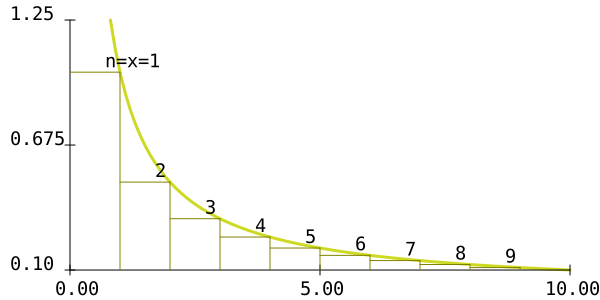
In summary, the integral of the hyperbola was used by Euler to approximate the Harmonic series, elucidating the subtlety of the divergence of the series, as the logarithm is slowly changing, but unbounded.