Integrals 1: The Fundamental Theorem of Calculus
The area under a curve is calculable from the function itself, and we will see that equipped only with the derivative, and definitions entailed by it, we constrain the form of its inverse, in \eqref{derivative-inverse}, and subsequently we demonstrate the methods to arrive at the antiderivative with a few examples. Integration is analogous to the arithmetic of subtraction, of which we constrain the product algebraically by the operation we understand more fundamentally: the operation of addition.
$$ x=a-b \quad \to \quad a=x+b $$
Integration is similar in that the final test of it is that its derivative is the integrand.
Fundamental Theorem of Calculus
Stated tersely, the Fundamental Theorem of Calculus (FTC) is as in the following equivalency:
$$\begin{equation}\label{FTC-eq} F = \int f \, dx \quad \to \quad f=F' \end{equation}$$
As we'll see in this article.
Definitions
Riemann Integrability
An integration is continuous on a continuous domain (some interval as a subset of $\mathbb{R}$), as opposed to the sum of unit width rectangles such as is the case of natural or integer indexed series. If the function being integrated, called the integrand, has steps in value (finitely discontinuous) on the interval, the the area under it is continuous since any size slice of a rectangle is possible. This is less of a constraint on the integrand than the restriction on the derivative's argument, being continuity, with the same resulting quality of continuity.
In addition to being a single valued function, integration requires that its values be bounded by two step functions, with one above the integrand's maximum value of the range of values the function takes within delta of any given point on the interval, and one below the function. The range of function values within delta of a point $t$ will stay the same for points at a step, while shrinking the difference in bounding functions for points away from the stepping points.
The Riemann Sum
The Riemann Sum is the discrete calculation of the area under a function, using a sum of partition rectangles fit to the curve. If the value of the function over any section of the interval is negative, then that section contributes the negative of the area above the curve and below the $x$-axis, which is negative.
Two different partitions of the interval will in general yield different sums, but what we're most concerned with is the limit of the sum as the partition number goes to infinity.
$$ \sum_{i=0}^n f(t)(t_{i+1}-t_i) =\int_a^x f(t) \, dt = \left. F(t) \, \right|_a^x $$
The partition size, \eqref{partition-size}, is employed, $\text{size}=(t_{i+1}-t_i) = \frac{x-a}{n}$.
This discrete method can be used to calculate the integral without analytically knowing the antiderivative of the integrand.
The Riemann Integral
The Riemann Integral is defined as the limit of the Riemann Sum as the partition number goes to infinity.
The integrand is on the left hand side (LHS) and integral with evaluation bar and integration limits (interval endpoints) on the RHS, with the indefinite integral represented by $F$ here:
The antiderivative is the inverse operation of the derivative at any point over an interval plus an undetermined constant. The derivative of a constant is zero, so up to the value of a constant the integrated function is determined. The constant of integration in the indefinite integral is void in a definite integral, as it is cancelled by their difference at the endpoints, \eqref{derivative-inverse}:
Integral of a Constant
The Riemann Sum of a constant is the simplest example.
$$ \sum_{i=0}^n c = c(x_1-x_0) + c(x_2-x_1) + \cdots + c(x_n-x_{n-1}) = c(x_n-x_0) = c(x-a) $$
If we reuse the capital-$F$ for the definite integral as well, as the area between the curve, $y=f(t)$, and the $t$-axis, then we can say immediately about the integral of a constant function, as seen in Figure 1 (below), that the integral of a constant, $c$, with respect to (WRT) any abscissa variable, here it is $t$, depends linearly on the variable endpoint, labelled $x$:
The variable $t$ is the integration variable and the infinitesimal symbol uses a unique form of two letters for the single variable, here $dt$, and also appearing interchangably as delta-$t$, or to signify some finite subinterval $\delta t$. In the last step of \eqref{integral-constant}, the variable now integrated is used to form the final form of a definite integral, which is the difference of the indefinite integral evaluated at the two endpoints.
Verify that the derivative of the integral with respect to the endpoint in the definite form is the integrand, $f(t)=c$, or WRT the integration variable in the indefinite form, the same result is arrived at in \eqref{integral-constant} that $f=F'=c$.
The area, $F$, is a function of the interval, for some interval, $[a, x]$, that is: $F=F(a, x, f)$.
Verify that for \eqref{integral-constant} the integral value attains zero for equal endpoints, $x=a$, as it always must for any integrand.
Constant Function with Discontinuity
A derivative is only defined if the function is smooth, so the fact that an integral is always continuous satisfies that aspect of the FTC, eq. \eqref{derivative-inverse}.
Integral of the Identity Function
The next most primitive integrand after the constant function is the identity function. We will see here that the Riemann Sum from zero to $x$ for the identity function is convergent to the Sine Rule for Area applied to the right triangle formed by the Sum over the interval, $[0,x]$.
Below we look at this RS over the domain, $[0,10]$:
The RS is constructed as follows. For a variable partition number, $n$, we have the partition size, $w$:
$$ w = \frac{x-0}{n} $$
So, the values of $t_i$ are related to the $w$, where $i$ is the index variable:
$$ t_i = i w = \frac{ix}{n} $$
The rectangles in Figure 3 (above) are represented by the following expression for $S$:
$$ S = \sum_{i=1}^n t_i w = 0 + \frac{x}{n}w + \frac{2x}{n}w + \cdots + \frac{nx}{n}w $$
The RHS can be simplified to the following:
$$\begin{equation}\label{rsum-identity-function} S = \left(\frac{x}{n}\right)^2 \sum_{i=1}^n i \end{equation}$$
The sum of $i$ is evaluated by observing that there is a pattern in the sum, combining the first and the last in the series we notice that this nesting pattern forms a constant term using the first and last, second and second to last terms and so on, then each term is $1+n$, and there are $\frac{n}{2}$ instances of them.
$$\begin{equation}\label{sum-over-i} \sum_{i=1}^n i = (1 + n) + (2+ (n-1)) + (3 + (n-2)) + \cdots + (1+\frac{n}{2} + (n - \frac{n}{2})) \end{equation}$$
By combining \eqref{rsum-identity-function} and \eqref{sum-over-i}, we have:
$$ S = \left(\frac{x}{n}\right)^2 \frac{n}{2} (1+n) = \frac{1}{2}x^2(1 + \frac{1}{n}) $$
In the limit that the partition number goes to infinity, the RS converges to:
$$ \lim_{n\to \infty} S = \frac{1}{2}x^2 = \int_0^x t\, dt $$
Verify the FTC, \eqref{FTC-eq}, for the identity function:
$$ \frac{d}{dx}\frac{1}{2}x^2 = x $$
Induction on the Interval
Next, using the inductive method here, and building up an interval from zero ($x\gt a$, in \eqref{integral-constant}),
The change in $F$ for a given change $b$ is $\Delta F = F( a, x + b, f) - F(a, x, f)$. So, to use the Greek letter Delta (for the root of difference diaphora) to symbolize the difference of the quantity:
Eq. \eqref{delta-F} is the formula for (small) change in the integral for a small change in endpoint argument, $x$, which represents the rectangle of (small) width $b$ and height $f(x+b)$.
If the integrand, $f$, is continuous (and not integrable alone) then the absolute value of the difference between $f(x+b)$ and $f(x)$ is less than $\epsilon$ for the step size (partition, $b$), so $b(f(x) - \epsilon) \le \vert{}\Delta F \vert{}\le b(f(x) +\epsilon)$, and so for infinitesimal partition size the error goes to zero ($\epsilon \propto b$), but it's not the only acceptable type of integrand. Integrals apply to step functions too, which include those discontinuous functions which step for a single point (zero width) or curves which have a finite set of such exorbitant points along the interval.
Thus a simply integrable function yields a continuous integral in $x$, or alternatively in the first endpoint, $a$, with some sign (negativity) business.
Inverse of Tangent
The change in the area per change in interval endpoint is proportional to that change, ($\Delta x = b$), and also to the value of $f$ at $t=x+b$.
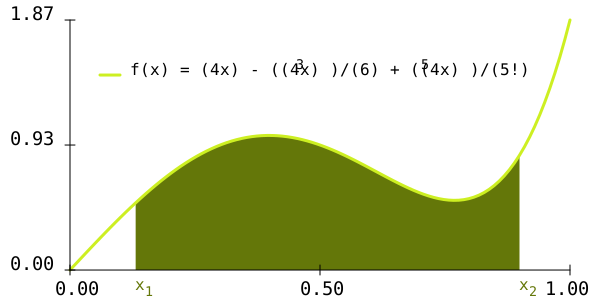
The area between function $f$ and $y=0$ (the line with zero slope and zero as $y$-intercept) over the bounded yet imprecisely defined interval, $[a, x]$, is the filled region.
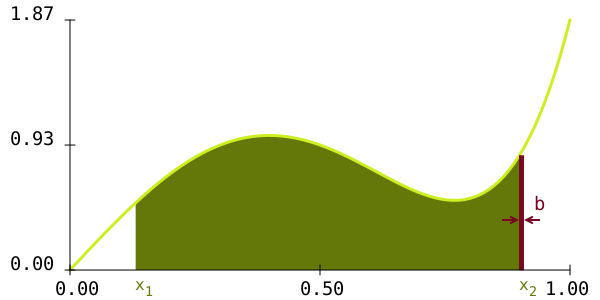
Notice that the integral is not a function of the abscissa variable, $t$, which is an intermediate parameter. The additional area acquired by extending the interval boundary by $b$ is simply the value of the function at $(x+b)$ times the width, the differential parameter $b$. The finite differential parameter can be thought of as the partition size of the Riemann Sum,
We can say the quantity of such area is, in general, a function of the following parameters.
- $f(t)$, the curve of integrable function values making the top boundary,
- $t=a$, which defines the left boundary of the integral,
- $t=x$, defining the right boundary.
Where the fourth bounding line, the $x$-axis (conventional name, used here as $t$-axis), is constant. So the area which is bounded between $f(t)$ and the $t$-axis, over the interval, $[a, x]$, can be solved by the differential equation, $D_x F = f$, which is identical to the derivative formula for $f$, except now the derivative is labelled as $F'=f$. We write:
$$ \lim\limits_{b\to 0}\frac{F(a, x+b)-F(a, x)}{b} $$
$$ =D_{x} F(a, x) = f(x) $$
The limit of the infinitisimal unit as going to zero is formal, and if you recall the derivation of the several derivative rules in Derivatives, the limit argument works for, $0\le b\ll 1$, which bounds the infinitesimal unit, $b=dx$, to be much smaller than unity.
Where we've identified the form of the derivative as function of $x$, and not of $t$ nor of $dt$.
So for arbitrarily small $b=\Delta t$, the ratio becomes the derivative of $F$ at $x$, and is equal to $f(x)$. This immediately tells us that the area function, $F$, is the antiderivative of the function $f$.
$$\Delta F = F(x+b) - F(x) = b f(x) $$
Which is equivalent to the FTC, \eqref{FTC-eq}.
For historical placement of this notion, the antiderivative of $x^{-1}$, Harmonic Series, was solved by Gottfried Leibniz in 1676, first publisher of the formalism of calculus [1].
Polynomial Integrand
An example polynomial integrand, $f$, is a truncated sine series, with a frequency of $4$, up to sixth degree in the Taylor series.
For the example curve, depicted in Figure 6 (above), the integral of the polynomial is evaluated term by term using the antiderivative of the monomial.
The integral of a sum of functions (in this case, a trinomial) is the sum of the integrals of those functions. This follows from the linearity of the derivative: since the derivative of a sum is the sum of the derivatives, the antiderivative shares this property.
$$ D_x\sum_i f_i(x)=\sum_i D_x f_i(x) $$
Since $D_x (f_i + f_{i+1}) = D_x f_i + D_x f_{i+1}$:
$$ \frac{d}{dx}(f_i + f_{i+1}) = \lim_{dx\to 0}\frac{f_i(x+dx) + f_{i+1}(x+dx)-f_i(x) - f_{i+1}(x)}{dx} $$
$$ = \lim_{dx\to 0}\frac{d f_i }{dx}+\frac{ d f_{i+1}}{dx} $$
So, the integral of the function figured is:
Since the derivative of eq. \eqref{integral_f} is f, we verify the antiderivative is correct for a small polynomial.
- [1] Scriba, Christoph J. (1963). The inverse method of tangents: A dialogue between Leibniz and Newton. Archive for History of Exact Sciences 2 (2):113-137.